Inside the ICC’s bet on women’s cricket
Ten years of work have lifted women’s cricket to record crowds and viewing hours. The business is still being priced in.

In 2017, the Women’s World Cup final sold out Lord’s, cricket’s spiritual home. Women had held full membership there since the spring of 1999, but the pavilion’s habits lagged its rulebook; it would be years before they sat on the Marylebone Cricket Club committee in numbers that meant anything. That Sunday, India lost five wickets for 23 runs in a few frantic overs and, with them, a match they had almost won, slipping to a nine‑run defeat to England.
Nine years on, the grandstands will again this Sunday for the ICC Women’s T20 World Cup final. England and Australia arrive unbeaten, fronting a tournament that never really needed a marketing push to sell out. Packed corporate boxes and a pre‑match set from Rita Ora will share the stage with the match itself.
Sanjog Gupta, who became chief executive of the International Cricket Council (ICC) in July 2025, has repeated one ambition often enough that it no longer sounds like a line: to make women’s cricket “the biggest women’s sport on earth.” He tells The State of Play that it is “definitely a realistic ambition to have.”
“Given what we’ve seen with women’s cricket and its growth over the last five years, and also if one was to start looking at the markets that have already been activated for it, there’s an opportunity to make cricket the most viewed women’s sport in the world,” Gupta says.
This is the decade of work behind that line: changing how the women’s game is filmed, funded, and sold, and now seeing whether it can stand on its own.
For most of its first decade, the Women’s World T20 was not its own show. From 2009 to 2016 it sat inside the men’s tournament: same venues, same dates, and afternoon starts. The women’s semi‑finals and final went on before the men took the evening, a warm‑up act.
In 2018, the ICC took the tournament standalone and rewrote its production standards. A year earlier, at the 2017 World Cup, only ten of the 31 matches had been broadcast with a full 30-camera set‑up; the rest went out thin or not at all. At the 2018 edition in the West Indies, every match was produced live for more than 200 countries.
By 2025, every match was covered by 30 cameras. Games expected to rate and those that never used to look the same now.
Gupta gives two reasons for the investment. “Cricket is an ecosystem where half the world hasn’t been included, represented or enlisted as the second half, and that’s the philosophy behind the moves we’ve made to grow women’s cricket,” he says.
The second reason is more operational: an ICC event, done properly, becomes “a platform for commerce, culture, creativity, and connection,” and the perception of that event rests entirely on the broadcast – both its production quality and the marketing that turns a passing viewer into an actual fan.
The audience the cameras found
The clearest sign that something new was brewing came in 2020, on a chart nobody in the game had needed before.
In February that year, India reached their first Women’s T20 World Cup final, at the Melbourne Cricket Ground in front of 86,174 people. The ICC's digital video views for the tournament passed 700 million by the group stage alone, more than twenty times the 2018 edition and ten times the 2017 Women's World Cup.
Indian viewers watched 2.46 billion minutes across the tournament's first 12 matches alone, more than three times the 787 million minutes those same fixtures drew in 2018. The final alone accounted for 1.78 billion minutes, fifty‑nine times the 2018 final. Star Sports carried India’s matches in five languages instead of English alone – and the numbers justified every production call that followed.
Five years on, that audience is both larger and more concentrated.
The 2025 Women’s Cricket World Cup, hosted and won by India, generated 1.5 billion global viewing hours, more than triple those of the 2024 T20 World Cup. Two matches accounted for almost half that total, both involving India. The best‑performing game that didn't draw a fraction of what sat on either side of it. [See graphic]
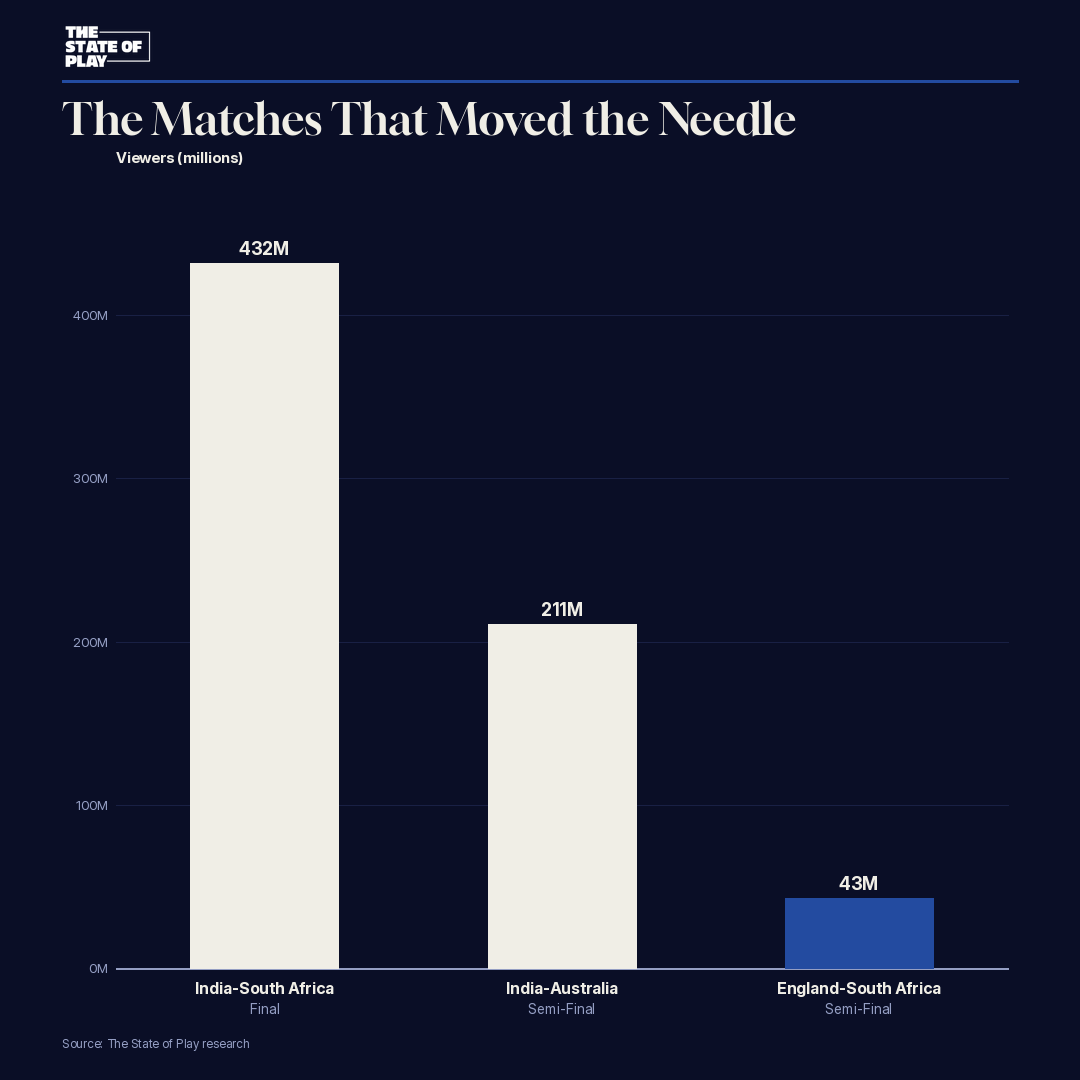
Broadcasters outside India moved with those numbers. Coverage hours for the 2025 tournament grew 3.37 times in India, 6.2 in the UK, 5.8 in the US, and 5.2 in Pakistan, all rising faster than the cricket itself. Gupta pushes back on reading that as an India problem.
“It’s not just India, but the Indian subcontinent. Between India, Pakistan, Bangladesh and, increasingly, Sri Lanka and Nepal, Afghanistan will continue to constitute cricket’s biggest market in terms of numbers, which is why the share of this region in the global viewing numbers will always seem inflated,” he says. “Is India cricket’s biggest market today? Yes, it is. But that doesn’t mean that markets beyond India are not priorities, or for that matter not avenues for potential growth.”
England 2026 rests on the assumption that the audience keeps growing, and it has done so while competing against the biggest sporting event on the calendar. The Men’s FIFA World Cup, the first with 48 teams, is running across the same six weeks, in the same attention economy, from June 11 to July 19.
The tournament runs in 14 languages, with free-to-air deals into markets that had never carried the women's game: JioStar, Sky Sports, and a new YouTube partnership reaching Nepal, Germany and beyond. That YouTube tie-up alone has drawn more than 150,000 hours of watch time in places that had never seen a live women's broadcast before.
The opening weekend delivered 215 million in reach and 1.3 billion minutes of watch time on JioHotstar. India’s group‑stage win over Pakistan accounted for 134 million of those viewers and 1.1 billion of those minutes, the largest audience any league‑stage match has drawn in the sport’s history. Sky’s opening night peaked at 510,000 viewers and averaged 393,000, its highest figure for a single match.
Gupta resists measuring the tournament’s spread by simple headcount.
“If we make the mistake of comparing the hundreds of thousands of fans who are in‑stadium in the UK with the millions watching in India, we will always feel that one market is significantly smaller than the other,” he says. “The way to judge markets is by the impact you are creating in those markets and what you believe is core to the growth of the sport in the future.”
Built for the feed
For most of its life, cricket treated pictures of itself as private stock, locking down footage and chasing takedowns. For this tournament, the ICC flipped the script.
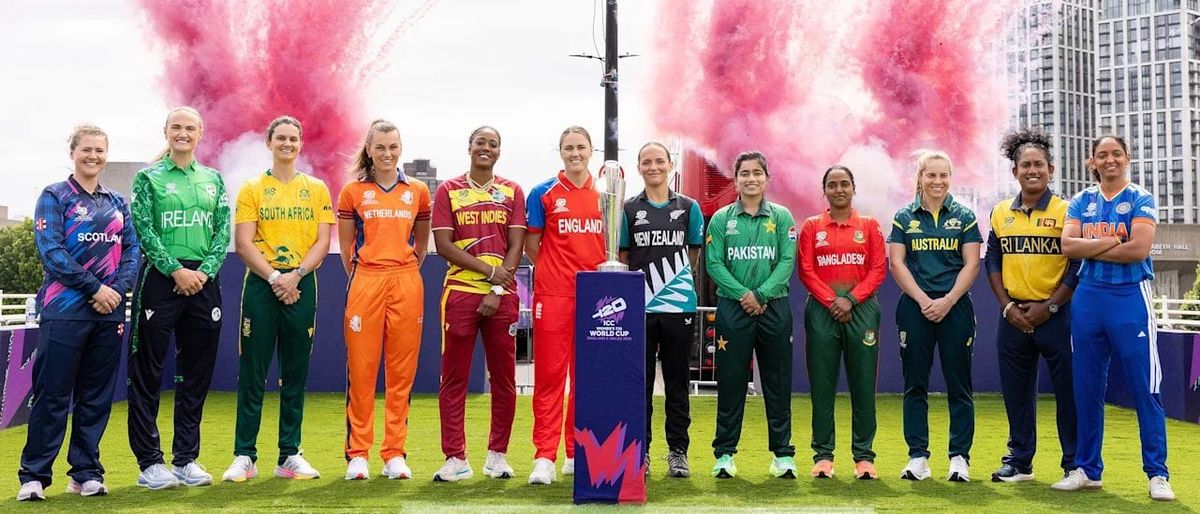
Through the T20 Creator Club, it flew dozens of independent creators to the UK. It let them in the door: team media days, warm‑up matches, the Captain’s Carnival on Waterloo Bridge, where London traffic stopped while twelve captains stepped off a red bus onto a strip of AstroTurf.
The creators filmed what they wanted. Over the opening weekend, their work generated more than 617 million video views and 30 million engagements, while the ICC's own channels drew 753 million views, a 150 per cent rise on the same period in 2024.
By the halfway mark, Gupta posted the fuller numbers on LinkedIn. Nineteen matches into a 33‑match schedule, he wrote, ICC channels had already drawn 1.7 billion views, more than the whole of 2024.
The most‑watched clip of the tournament so far is not a hundred or a last‑over finish but India’s Shreyanka Patil hurling herself full length to take a catch against Pakistan, a moment that has passed 100 million views.
Gupta says that is exactly what the Creator Club was meant to do. “Fans around the world increasingly watch through the eyes of others. There is a sense of community in engaging with those whose views of the world ‘I trust, so I follow’,” he says. Most of the creators the ICC brought in have nothing to do with sport, let alone cricket. “We also want to expand audiences and reach perspectives and communities that are not already plugged in,” he adds.
Cricket’s core audience still sits in South Asia, on subcontinental streaming platforms. Growing beyond that, with the sport heading back to the Los Angeles Olympics in 2028, means reaching people who were never going to pay for a cricket subscription.
What the money says
The prize pool moved first. Since 2024, every ICC event has paid men and women equally, seven years ahead of the target the council set in 2023. Cricket remains the only major global team sport to have closed that gap. The 2025 Women's World Cup carried a total purse of $13.88mn, a 297 per cent increase on 2022, and for the first time exceeded the entire prize fund of the last Men's Cricket World Cup, held in 2023.
“Yes, it is the right thing to do. It is not just the right social thing to do. It is an investment that is being made in a product that you want to drive beyond its initial adoption stage,” Gupta says. “Prize money is an indicator of how the two products may be at different stages of evolution but are not necessarily different in terms of their priority.”
The economics have not caught up with the audience. The 2025 Women’s Cricket World Cup lost $31.4 million on its own account, according to the ICC’s own audited financial statements. Six months earlier, the 2025 Men’s Champions Trophy, run by the same council, posted a surplus of close to $587 million. [See graphic].
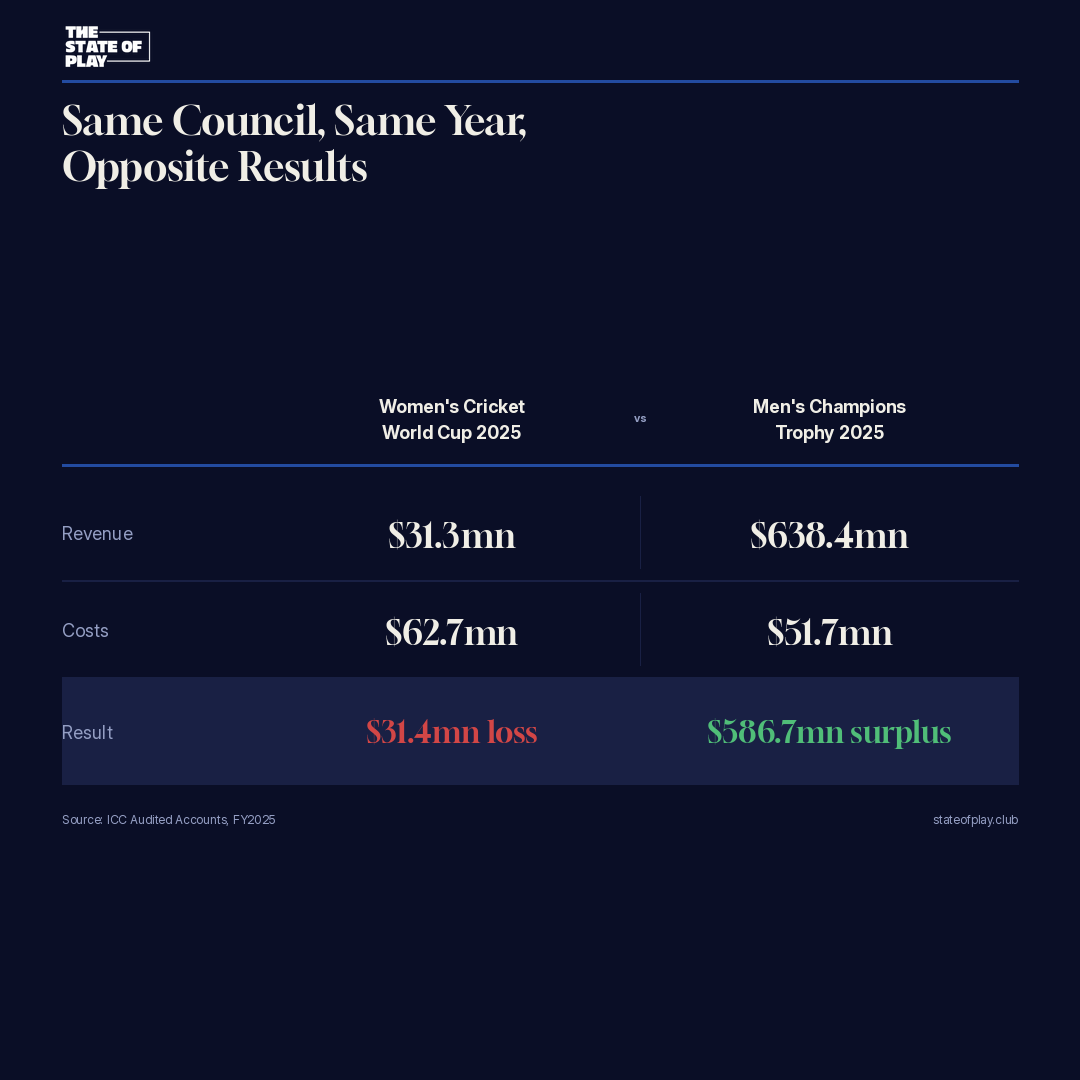
Until the current 2024‑31 cycle, partners treated men’s and women’s rights as a single bundle, so a brand could claim women’s cricket without ever using it. Now ICC splits those rights at the second sponsorship tier, forcing partners to choose the women’s game outright. Unilever became the first standalone backer of ICC women’s events in 2025, on a three‑year, $2 million‑a‑year deal built around grassroots access. Google followed as the second, signing a three‑year package worth $3.8 million a year across AI, payments and smartphones. It has since expanded its ICC presence to include men’s events for 2026‑27.
Gupta traces the room still left to grow to a shift in who's actually watching. "The product is available in abundance. Is it at a scale we want? No, there's definitely headroom for growth," he says. The initial adopters, in his account, were the existing core audience for men's cricket, who reassessed their assumptions and kept watching for reasons unrelated to the men's game.
The accounts record losses. Inside the ICC, those cheques are simply the cost of building the market it says it wants.
From one‑off to habit
Nobody expects a new category to pay for itself in its first decade. What the ICC has built since 2020 looks less like a struggling tournament and more like an asset still being priced: cameras, language feeds and creator programmes in place before the market has fully turned up.
Gupta says the difference is one of life stage, not ambition. “Both products, the men’s product and women’s product, increasingly need to be developed by themselves, almost with individual product strategies and, potentially, even business models,” he says. “They are also at very different stages of maturity. Women’s cricket is still in its investment stage; we are still investing significantly to grow affiliation for women’s cricket. While men’s cricket currently enjoys an already strong core, the imperatives for growth of men’s cricket may look very different from those that are for women’s cricket.”
India's run to the 2025 title turned the Women's World Cup into a domestic event with global reach. When India went out in the group stage a week before Sunday's final, beaten by Australia in front of 27,163 at Lord's, the largest crowd for a group game in this tournament, the audience did not leave with them.
Gupta thinks the crowd is already ahead of the numbers on the page. What happens in the next rights cycle, and at the Olympics in Los Angeles in 2028, where the women’s tournament runs on its own line for the first time since 1900, will show whether the rest of the market agrees.
“2028 LA is a platform for cricket, and particularly women’s cricket, to leapfrog in what we call greenshoot markets,” he says, arguing that the Olympic movement gives cricket a way to reach people who have never tried the sport, and gives national bodies a reason to invest.
In 2017, a woman could fill Lord’s for a World Cup final and still feel like a guest in the room that mattered. On Sunday, the same ground fills again, for a final without India. This time nobody has to explain what she is doing there.