Google’s longest game
Google has spent fifteen years embedding itself into cricket's ecosystem: as a platform, a sponsor, a rights-market observer, and now a kingmaker. The sport's two biggest auctions arrive in 2027. The groundwork is already laid.

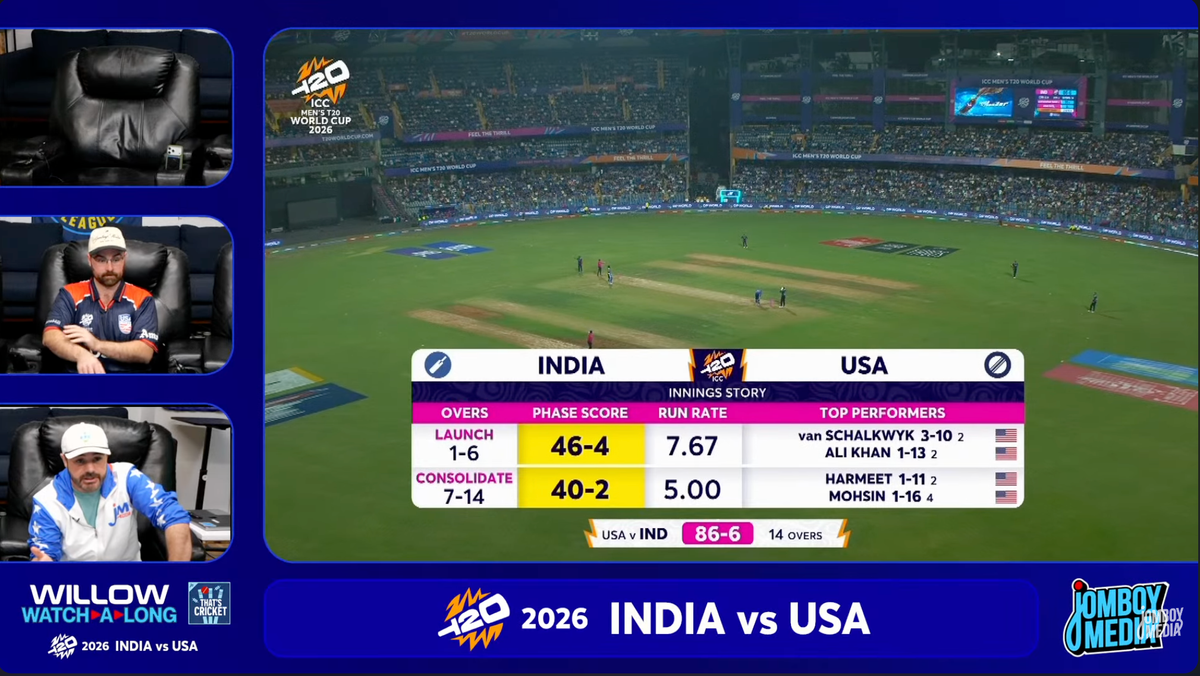
A bruised, pre-dawn silence usually hangs over the West Coast at 5 am, but on February 7, a different kind of energy flickered through the dark. A massive, uninitiated American audience sat down with their coffees to watch the United States play India at the T20 World Cup, guided by a voice that felt more like a friend in a sports bar than a broadcast professional.
Jimmy O’Brien, the New Jersey-born sports creator known as Jomboy, was the guide. O’Brien discovered cricket during a two-year stay in New South Wales, Australia and spent years honing a style of breakdowns that made the sport’s dense, rhythmic complexities digestible for the American baseball mind.
The Jomboy Media YouTube channel became a makeshift town square. The two-match stream, offered to anyone with an internet connection, pulled 2.6 million views across all of Jomboy Media's platforms. The live chat generated 11,000 messages. “Had no clue we even attempted cricket as a country,” one viewer noted. Another: “I would have never understood what was going on without their commentary.”
This was a calculated manoeuvre executed at the highest levels of the tech industry. Satyan Gajwani, chairman of Times Internet Limited (TIL), which owns Willow by Cricbuzz, negotiated directly with YouTube CEO Neal Mohan. Their agreement effectively dismantled the paywall, dropping the ICC Men’s T20 World Cup to the centre of the American digital mainstream without a price tag.
“How do we make cricket more widely accessible and visible in the US? We spoke to a few broadcasters and OTTs, and ultimately, the biggest platform is YouTube,” Gajwani told The State of Play. “We wanted to, at least in the US, let the team USA matches be accessible, because the casual patriotic American fan might be interested in watching, especially if the US team had done really well, like in 2024.“
Google is the only entity in cricket’s ecosystem constructing the sport’s future with a pincer movement: from the top down, through institutional sponsorships and CEO-level franchise investments, and from the bottom up through a creator infrastructure that already owns the conversation before a single ball is bowled. JioStar controls the live product. YouTube, increasingly, controls everything around it. The Indian Premier League’s (IPL) digital rights and the International Cricket Council’s (ICC) global event rights are both slated to return to the market in 2027. Google has not said it is coming for them. It has done something more effective: made itself the oxygen the game breathes.